
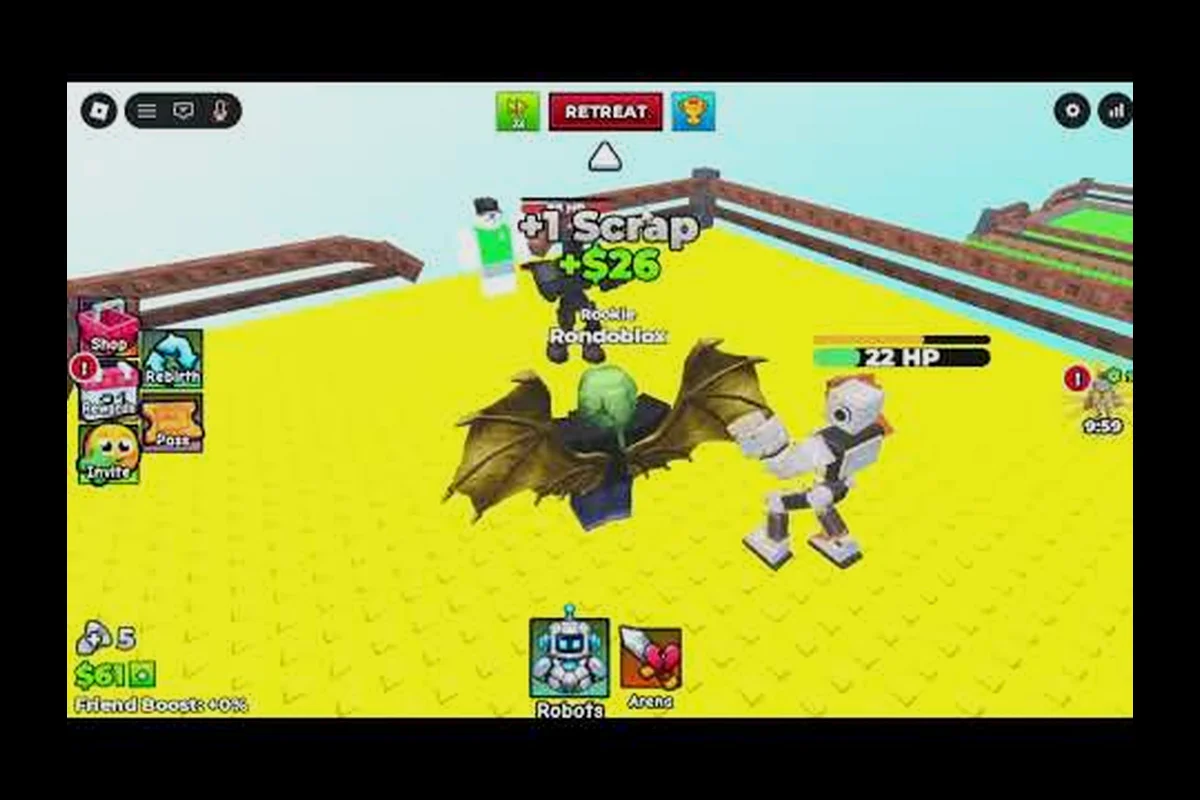
Steel Fighters floor progression is easier to master when each stage has a clear purpose: collect scrap, strengthen the team, and preserve enough power for the next tougher room. This Steel Fighters floor guide explains the milestone path through Floor 30, the endless-floor structure, and the preparation needed to keep clearing rooms efficiently.
Steel Fighters Floor Guide: Milestones Through Floor 30
Steel Fighters is built around assembling robots from interchangeable parts, collecting scrap, and using stronger teams to defeat increasingly difficult enemies. The official Steel Fighters page on Roblox identifies more than 100 robots, endless floors, bosses, part upgrades, and rebirths as central features, so floor progress depends on more than repeatedly pressing an attack button.
The official description confirms the game’s endless-floor structure but does not establish a finite total. As a result, questions about Steel Fighters total floors and the Steel Fighters floor cap should be answered carefully: Floor 30 is a prominent player milestone, while later floors remain part of the Steel Fighters endless floors rather than a verified final level.
| Milestone | Main goal | Preparation focus | Expected result |
|---|---|---|---|
| Floor 1 | Establish the combat loop | Starter robot and basic attacks | Learn room entry and target selection |
| Floor 5 | Build a dependable squad | Core part upgrades and scrap | Create a consistent first team |
| Floor 10 | Survive stronger enemies | Balanced stats and team size | Reach the first major checkpoint |
| Floor 20 | Push through late scaling | Rebirth gains and refined upgrades | Reduce resets during floor attempts |
| Floor 30 | Reach the featured milestone | High-value parts and boss readiness | Enter the floor-30 milestone push |
What the endless structure means
Because Steel Fighters endless floors continue beyond the featured milestone, the useful goal is not to hunt for a nonexistent last room. Instead, treat every ten floors as a checkpoint: evaluate damage, team composition, scrap income, and the point where a short run becomes inefficient. That approach answers Steel Fighters how many floors in practical terms without claiming a capped total that the official source does not confirm.
Each floor adds a decision point rather than simply increasing the waiting time. Players must decide whether to enter immediately, farm weaker rooms for scrap, or return to the Junkyard for upgrades. Community walkthroughs also connect stronger robots, team play, and careful boss timing with reaching Floor 30, although the exact route can change as the game is updated.
Three progression layers
A reliable Steel Fighters floor guide separates progression into three layers: combat power, economy, and team value. Rather than judging a floor by the number of robots currently deployed, evaluate whether each robot can survive its intended matchup, whether the scrap needed for the next upgrade is available, and whether the lineup covers the floor’s damage pattern. This approach makes floor clears faster, preserves resources for later floors, and clarifies what to change when an endless-floors run stalls.
-
Combat power: Improve attack, health, and the parts that determine how consistently a robot survives.
-
Economy: Gather enough scrap to fund useful upgrades instead of spreading cash across every component.
-
Team value: Add robots when they contribute coverage, survivability, or damage rather than filling an empty slot.
This separation prevents a common mistake: replacing every weak robot immediately. A wider team may survive an easy floor, but a focused team with upgraded parts can make each encounter faster and make the next floor reachable. For further growth after a reset, the guide to leveling up faster in Steel Fighters can help connect upgrade decisions with the broader progression system.
Preparing Before Entering a New Floor
The best preparation happens between floors, not during the final loading screen. A Steel Fighters how to beat floors approach should begin with a quick audit of the team, available scrap, and whether a rebirth would create a meaningful power advantage. This check takes less time than recovering from several failed attempts against an enemy that significantly outpaces the current build.
The core preparation checklist is straightforward: compare your current scrap balance with the cost of the next planned upgrade, then decide whether another floor is needed. For example, if a team-wide damage upgrade is only a few scrap short, clear one suitably weak room rather than replacing a useful bot with a lower-tier unit. This preserves upgrade progress while testing the lineup against the Steel Fighters endless floors, reducing the risk of entering a harder floor with incomplete power scaling.
-
Confirm that each active robot has its most valuable upgrade at least partially completed.
-
Remove bots whose damage or durability is far below the current floor requirement.
-
Keep one dependable damage dealer when experimenting with a wider lineup.
-
Keep one durable robot for enemies that are difficult to finish quickly.
-
Enter a floor only after the team can handle a normal room with limited margin for error.
-
Save enough scrap for the next upgrade before farming another low-level room.
The upgrade-before-rotation rule is especially useful early. If a single upgrade can materially improve the whole team, complete it before chasing another random part. Players who want a more granular breakdown of the fastest room-by-room route can use the fastest floor-clear routine in Steel Fighters.
Assess the team in three passes
Start with survivability. If robots lose most of their health before they can damage the enemy, no amount of waiting will produce a clean clear. Compare the active lineup with the floor’s recent enemies, then improve the weakest essential role rather than every stat equally.
Next, check damage consistency. A robot with a strong peak attack can still perform poorly if its basic attacks are unreliable or if it spends the battle out of position. Favor stable damage for normal rooms and reserve burst-focused robots for bosses or difficult targets.
Finally, evaluate economy. Lower floors can still be useful for scrap, but a farming floor should have an exit condition. Stop when the next planned upgrade is funded, then return to the milestone path. Unbounded farming makes Steel Fighters clear floors fast advice less effective because the player loses time without increasing the strength needed for progression.
Use a compact pre-floor checklist
| Check | Pass signal | Action if it fails |
|---|---|---|
| Team power | Normal rooms clear without losing most robots | Upgrade the weakest vital role |
| Role balance | Damage and durability are represented | Replace one of the weakest robots |
| Scrap reserve | Next planned upgrade is nearly funded | Clear a nearby farming floor |
| Boss warning | Current squad can survive the previous boss | Delay the boss and improve the team |
| Rebirth timing | Reset would provide a worthwhile multiplier | Check the rebirth requirements before resetting |
Clearing Steel Fighters floors quickly is not the same as pushing every Steel Fighters endless-floor attempt immediately. For example, if the next planned upgrade is still several thousand scrap short, a nearby farming floor can fund that exact robot replacement instead of being skipped; however, clearing past a boss with a weakened squad may cost more scrap through robot losses than the extra floor saves. The practical standard is to enter a floor with a stable damage-and-durability lineup, a defined upgrade target, and enough reserve to avoid farming multiple basic-resource rooms.
Floor-by-Floor Priorities From 1 to 10
The early floors teach the core loop, but they also determine how quickly the player reaches stronger milestones. A good Steel Fighters floor guide does not waste this stage by treating every robot equally or chasing random upgrades without a plan. The fastest early progress comes from fixing the fundamentals: complete useful part upgrades, create a balanced starting team, and learn which enemies create the most delay.
| Floor range | Main obstacle | Priority | What to avoid |
|---|---|---|---|
| Floor 1 | Learning enemy behavior | Survive and learn attack timing | Over-upgrading one bot |
| Floors 2-4 | Uneven enemy durability | Improve damage and coverage | Keeping several unusable robots |
| Floor 5 | First stable checkpoint | Build a repeatable squad | Switching teams every room |
| Floors 6-9 | More demanding combinations | Add useful roles and upgrade parts | Filling every lineup slot |
| Floor 10 | Major progression check | Reach the checkpoint with a strong core | Entering with an unfinished economy |
Floors 1 through 5
The first successful team is rarely the final team. Players should choose robots that can contribute immediately, then use the earliest floors to identify which parts produce the largest practical improvement. A slightly weaker but complete team often clears more rooms than a group built around one powerful robot that cannot survive long enough to use its strength.
At Floor 5, treat the checkpoint as a diagnostic. A clean clear suggests the team has a workable foundation; a difficult clear means the next priority is probably survivability or a missing damage role, not random expansion. The Steel Fighters boss list can then help connect milestone floors with the stronger enemies that appear later.
Floors 6 through 10
By the second half of the early route, efficiency becomes more important. Robots with a clear purpose should remain in the lineup, while duplicate roles can be replaced with units that add coverage. The goal is not maximum robot count; it is a squad that can enter the next room, eliminate threats, and move onward without a repair or reset loop.
At Floor 10, stop briefly and review three numbers: the time spent clearing normal rooms, the scrap remaining, and the state of the most important upgrades. If progress stalls there, farm only until the next meaningful purchase is affordable. A useful Steel Fighters rebirth guide can also clarify when a reset is worth considering before investing in temporary upgrades.
Floor 20 and Floor 30: Scaling the Strategy
Reaching Floor 20 means the basic progression model is working, but the margin for error is shrinking. Enemy scaling makes small stat differences more visible, and a team that cleared Floor 15 comfortably may now spend too long inside a room. The practical answer to Steel fighters how to beat floors at this stage is better preparation, not more repeated attempts with the same configuration.
| Checkpoint | Primary pressure | Team adjustment | Economic focus |
|---|---|---|---|
| Floor 20 | Enemy strength outpaces basic upgrades | Balance the team and remove weak units | Fund high-impact parts |
| Floors 21-25 | Damage checks last longer | Strengthen the primary attacker | Avoid unnecessary purchases |
| Floors 26-29 | Boss pressure and floor transitions | Keep a dependable survival role | Save for the next milestone |
| Floor 30 | Featured late-game checkpoint | Enter with a boss-ready squad | Use scrap only on clear gains |
Rebirth before the late push
Rebirth becomes more valuable when upgrades have reached a point where small purchases no longer move the needle quickly. Before resetting, confirm that the new multiplier creates enough additional power to offset the time required to rebuild. A reset performed with no plan can make a strong Floor 20 team feel weaker, while a well-timed reset can shorten the path toward Floor 30.
Player guides emphasize that XP, upgrade decisions, and rebirth timing are closely connected. Treat the reset as part of the floor strategy rather than a separate activity. If the current team already reaches the next checkpoint comfortably, keep pushing; if several upgrades are needed and the rebirth bonus is large, the reset may be the more efficient route.
Prepare specifically for Floor 30
Floor 30 should be treated as a test of preparation rather than an ordinary room. Players reported by community walkthroughs emphasize stronger robots, team size, and boss timing as the main tools for reaching the milestone. Those observations align with the official game features: combining robots, upgrading parts, and facing powerful bosses all contribute to late-floor readiness.
A practical preparation sequence is: first establish a stable core of two robots, then use nearby clears to compare parts rather than scrap totals, because damage output, durability, and boss coverage are the variables that decide whether the lineup can handle Floor 30. The robot combination system supports this approach: adding a new unit is useful only when it closes a weakness in the current damage or tank roles. Players who reach the milestone through the Steel Fighters endless floors tend to arrive with a focused, upgraded lineup instead of a crowded formation of weak robots. This makes Floor 30 a checkpoint for build quality, not merely the number of robots deployed.
-
Clear the nearby floors without spending every scrap immediately.
-
Confirm the primary damage robot can defeat normal enemies consistently.
-
Check that the durable robot can survive the toughest recent encounter.
-
Review the boss list and note any special threat that the team lacks.
-
Use the final pre-milestone rooms to earn any remaining upgrade cost.
-
Attempt Floor 30 with the strongest practical lineup, not simply the largest lineup.
The team-size point deserves emphasis. Adding robots can improve coverage, but every active unit also needs enough value to justify its position. Community demonstrations of a Floor 30 push support adding useful robots, not adding weak ones. This is also where the specialized Steel Fighters floor-30 route can provide more focused milestone planning.
How to Clear Steel Fighters Floors Faster
Fast clearing comes from reducing decision time and unnecessary fights. A strong Steel Fighters floor guide identifies where players lose minutes: repairing after failed attempts, entering weak rooms, spending scrap in the wrong order, and using bots that do not contribute. Remove those losses and progression naturally becomes smoother.
| Time loss | Symptom | Correction |
|---|---|---|
| Repeated deaths | The team survives only a few attacks | Upgrade health or replace the weakest role |
| Slow damage | Enemies remain active too long | Improve the main attacker’s output |
| Unstable lineup | Robots are added without a plan | Use role-based team selection |
| Excess farming | Scrap is plentiful but floor progress is low | Set a purchase-based exit point |
| Unfinished upgrades | Every room starts with pending costs | Finish priority parts between rotations |
Rotate with a purpose
A floor rotation should contain a clear target for each phase. Start with the floor immediately ahead, stop farming when the required upgrade is funded, and return to progression. This creates a repeatable cycle instead of wandering among stages with similar enemies and rewards.
Use the three-stage rotation to decide when each Steel fighters floor is worth farming and when progression should resume. A useful comparison is to record the upgrade cost, expected reward, and attempt result for each target floor: if a failed floor is only one upgrade away, repeat it; if the next floor offers a substantially better reward, advance instead. This keeps the endless floors route efficient while making every return trip to a cleared floor purposeful.
-
Push: Enter the next floor and test the current squad.
-
Repair: If the attempt fails, identify the exact missing role and buy the smallest upgrade that solves it.
-
Re-enter: Return to the failed floor and confirm the correction before moving on.
This method is especially useful for learning how to beat Steel fighters floors efficiently because it separates diagnosis from action. For example, if a floor attempt ends with the frontline unit dying before the boss is reached, check positioning first rather than buying a large damage upgrade; if the squad survives the opening wave but loses to the boss’s enrage timer, then improve damage or unit survivability. This targeted sequence prevents expensive changes when a simple repositioning, upgrade choice, or timing adjustment would have solved the Steel fighters floor, while also making each return to a cleared floor a controlled test rather than a blind repeat.
Keep the active team disciplined
A disciplined lineup contains a dependable core plus enough variety for difficult encounters. Change a robot only when there is a concrete reason: the current unit contributes too little, the new unit fills a missing role, or a specific enemy punishes the existing composition.
A focused strategy also makes it easier to estimate whether a rebirth is worthwhile. If every upgrade depends on one main robot, resetting before that robot reaches a useful threshold wastes time. If the new multiplier covers several essential parts, the reset becomes a clear gain. The cash and grinding routine in Steel Fighters can help players fund those purchases without spending an entire session on one upgrade.
Floor Cap, Total Floors, and What Comes After 30
The official Steel Fighters page describes the mode as endless and includes powerful bosses among its features. That supports the conclusion that Steel Fighters endless floors continue beyond Floor 30, even though the official source does not publish a single Steel Fighters total floors number. It is therefore inaccurate to present Floor 30 as the final floor or a confirmed Steel Fighters floor cap.
| Question | Best-supported answer | Reason |
|---|---|---|
| Is Floor 30 the final floor? | No | The official mode description calls the floors endless |
| Is there a confirmed Steel Fighters floor cap? | No published cap was confirmed | The official source does not list one |
| Is Floor 30 the main early goal? | Yes | Community guides repeatedly use it as a milestone |
| Can progress continue beyond Floor 30? | Yes | Endless floors and scalable progression support later attempts |
| What changes after Floor 30? | Stronger teams and tougher encounters | Later floors continue the same progression model |
The distinction matters because “total floors” can mean two different things. It may refer to the number of distinct floors a player has personally reached, which can continue increasing, or it may refer to a finite final level, which the official source does not identify. For progression planning, treat the personal total as an open counter rather than a completion screen.
Measure progress by power, not only depth
Reaching a higher floor does not mean every earlier concern has disappeared. Enemy resistance, upgrade costs, boss mechanics, and rebirth timing can still make a run inefficient, so late-game progress should be judged by how cleanly the current squad clears the next wave rather than by the floor number alone. A useful late-stage scorecard includes:
-
The highest floor reached.
-
The team that produced the best clear time.
-
The upgrade that removed the previous bottleneck.
-
The boss encounter that caused the most losses.
-
Whether the current rebirth state makes another reset efficient.
This information provides a practical Steel Fighters total floors strategy: push when team power is improving quickly, farm when one affordable upgrade is blocking progress, and rebirth when the multiplier will shorten the next attempt more than farming would. For example, if a single damage upgrade is too expensive for the current run but reachable after a few clears, farm that upgrade before attempting the next floor; if a rebirth multiplier cuts several seconds from every clear and the current squad can reliably reach the same checkpoint, rebirth sooner rather than sinking resources into a marginal upgrade.
Frequently Asked Questions
Does Steel Fighters have a final floor?
No final floor is confirmed on the official Steel Fighters page, which describes the progression system as endless. Floor 30 is a prominent community milestone, not a verified endpoint. Players can treat it as a major checkpoint while continuing toward later floors with stronger teams and upgrades.
How many floors are in Steel Fighters?
There is no confirmed finite Steel Fighters total floors count, and the game does not publish a verified Steel Fighters floor cap. The number a player has reached depends on time, team strength, rebirths, and upgrades. Floor 30 is a practical early goal used by many player guides.
What is the best way to reach Floor 30?
Reach Floor 30 by maintaining a balanced team, completing high-impact upgrades, and avoiding unnecessary farming. Add robots only when they contribute damage or durability. Before attempting the milestone, review boss threats and use a rebirth when its multiplier offers a faster route than continuing the current cycle.
Can weaker robots help clear floors faster?
They can, but only when they fill a missing role or improve coverage. A weak robot that contributes little can slow the team down because players must wait for it to contribute. Compare each addition with the current lineup and prioritize practical performance over simply reaching the maximum team size.
Should players rebirth before a difficult floor?
Sometimes. A rebirth can accelerate progress when the new multiplier covers several essential upgrades, but resetting too early can weaken a team that already clears nearby floors. Confirm the multiplier, review current upgrade progress, and compare the time required to rebuild with the time saved on the next push.